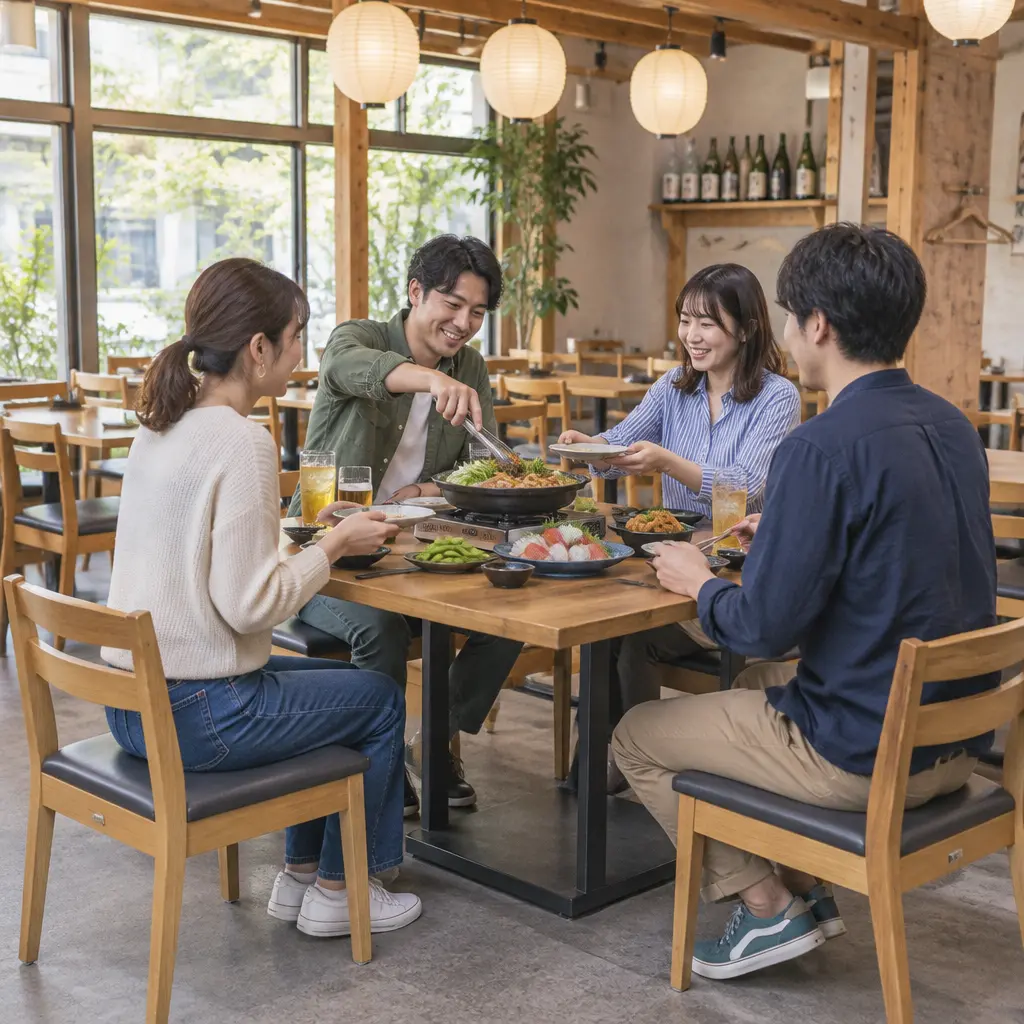
An izakaya is a Japanese-style pub where people gather for drinks and shared dishes, often ordering throughout the evening rather than following a fixed sequence. Contemporary izakaya etiquette is less about rigid rules than about making shared dining comfortable: check how the group wants to order, use serving utensils when practical, follow the host’s lead on drinks and payment, and be considerate of staff and nearby diners. Japan’s Agency for Cultural Affairs reports that washoku, or traditional Japanese dietary culture, was inscribed on UNESCO’s Intangible Cultural Heritage list in 2013; izakaya dining is not itself a UNESCO designation, but its emphasis on varied dishes and social sharing makes cultural context useful. The guidance below covers ordering, shared plates, drinks, payment, and how practices vary by venue.
Izakaya Dining Etiquette Defines a Flexible Set of Shared-Dining Practices
Dining etiquette in an izakaya means the customary ways diners coordinate food, drinks, space, and service in a casual Japanese drinking establishment. It is a practical social code, not a single official rulebook. The Japan National Tourism Organization (JNTO) describes izakaya as places where guests commonly enjoy drinks alongside a range of small dishes, often ordered for the table. That shared format makes communication and consideration more important than memorizing formal gestures.
The setting can range from a neighborhood counter to a busy chain restaurant or a polished modern bar. A useful baseline is to observe the room, ask when uncertain, and avoid treating one custom as universal. In Japan’s 2023 visitor survey, published by the Japan Tourism Agency, 22.2% of international visitors who reported an unmet expectation or problem during their trip cited difficulty communicating; the figure is a reminder that a few simple phrases and clear gestures can help, though it is not specific to izakaya etiquette.
Shared ordering and serving
Shared ordering means selecting several dishes for the table and letting everyone sample them. It is common, but guests may also order individual portions, particularly at counters or venues with set meals. When a dish arrives, use the serving chopsticks or spoon if provided. If none is offered, ask whether the group is comfortable sharing directly; norms differ, and some diners prefer a clean utensil or their own chopsticks’ unused ends.
Drinking and the first toast
The first toast is often made after everyone has received a drink. “Kanpai” means “cheers,” and waiting briefly for the group is a considerate default—not an obligation to drink alcohol. Beer, tea, soft drinks, and nonalcoholic cocktails are common alternatives. The National Tax Agency of Japan reported that domestic alcohol consumption per capita had fallen from 100 liters in fiscal 1995 to 75 liters in fiscal 2020, measured as beverage volume across alcoholic categories; this broad trend does not describe izakaya customers specifically, but it underlines why assuming every guest drinks is unwarranted.
Counter, private-room, and modern izakaya settings
A counter setting usually calls for compact belongings, a clear space, and awareness of the chef or staff’s service flow. In a private room, guests may have more room to talk, but should still keep voices and calls at a level that respects neighboring tables. Contemporary venues may use tablets, QR-code menus, or ticket machines; follow the displayed ordering steps and ask staff for help rather than guessing about charges or course requirements.
Izakaya Ordering Etiquette Balances Group Preferences with Clear Communication
Ordering etiquette is the set of habits that helps a group choose food and manage the pace of service. Because izakaya meals are often built from multiple small dishes, the table can order in stages: begin with drinks and a few quick items, then add dishes as the evening develops. This approach reduces waste and lets diners accommodate different appetites, dietary needs, and arrival times.
Check the menu format and any seating charge
Some izakaya serve an otōshi or tsukidashi, a small appetizer brought soon after seating and sometimes included as a cover or seating charge. Practices and prices vary by region and business, so do not assume it is complimentary or that every restaurant serves one. Check the menu, posted notice, or bill; if the charge is unclear, ask politely before ordering. Likewise, confirm whether a course menu requires a minimum number of diners or a time-limited seating period.
Order for the table without taking over
A considerate order gives everyone a chance to contribute. Ask about allergies and restrictions before choosing shared dishes, and make ingredients clear when relevant. When ordering for a group, repeat quantities and distinguish between individual portions and shared plates. If using a tablet or QR menu, verify that the order has been submitted; a dish shown in a digital cart may not yet have reached the kitchen.
Pace dishes and reduce food waste
Pacing means ordering a manageable amount first and adding more after the table sees portion sizes and appetite. This is especially useful when dishes arrive at different times or the menu includes filling items such as rice, noodles, or hot-pot courses. Japan’s Ministry of the Environment promotes “3010” food-loss reduction campaigns for banquets—enjoying the first 30 minutes and the final 10 minutes at the table—to encourage guests to eat what is served. It is a food-waste initiative, not a mandatory izakaya rule, but the underlying practice of ordering and eating thoughtfully applies.
Izakaya Table Manners Protect Shared Food and Dining Comfort
Table manners in an izakaya are everyday behaviors that keep shared food hygienic and the meal pleasant. Traditional Japanese dining conventions include using chopsticks carefully and avoiding certain gestures, but a casual pub setting is not a formal ceremony. Follow any utensils or instructions provided by the restaurant, and prioritize courtesy over anxiety about small mistakes.
Use chopsticks and serving utensils thoughtfully
When serving from a communal plate, use its serving utensil rather than your personal chopsticks if one is available. Avoid sticking chopsticks upright in rice or passing food from chopsticks to chopsticks, gestures associated with funerary customs in Japan. Do not point with chopsticks or leave them scattered across the table; rest them on a chopstick holder or the provided rest. If you are unsure how to handle a dish, asking is more respectful than making a performance of the rule.
Share space, sound, and attention
Izakaya can be lively, but considerate guests keep bags out of aisles, avoid blocking staff, and make room for dishes and drinks. Speak at a level suited to the venue, especially in small rooms where sound carries. Photographing food is generally unobtrusive if done quickly, but ask before photographing staff or other diners, and do not use flash where it may disturb people.
Respect smoking rules and venue policies
Smoking rules depend on current national and local regulations, the venue’s size and status, and designated smoking areas. Japan’s revised Health Promotion Act took effect in stages, with the main indoor-smoking restrictions beginning in April 2020; some establishments may still have permitted smoking rooms or fall under specific exceptions. Follow signs and staff directions rather than assuming that an izakaya is either fully smoking or entirely smoke-free.
Izakaya Payment Etiquette Varies by Group, Venue, and Occasion
Payment etiquette covers how diners settle the bill, handle service charges, and acknowledge the staff. There is no universal requirement to split evenly or for one person to pay. The least awkward approach is to agree early—particularly for a work gathering or large group—and check the restaurant’s payment options before the end of the meal.
Choose a fair way to divide the bill
A group may split the bill evenly, pay for what each person ordered, or have a host cover the meal. For a mixed group, clarify whether an even split feels fair when some guests did not drink alcohol or arrived late. Japanese restaurants may not support separate checks, especially during busy service, so ask before ordering if individual payment matters. Cashless payment is widespread, but payment methods still vary by business; check card, transit IC-card, QR-payment, and cash acceptance at the restaurant.
Pay at the designated place and avoid assuming a tip is expected
Many restaurants ask guests to pay at the register, while others bring a bill to the table. Follow the bill’s instructions or ask staff where to settle it. Tipping is not customary in most Japanese restaurants; leaving cash on the table can cause confusion. If a service or seating charge is listed, it is part of the bill rather than a tip. A simple “gochisōsama deshita” (“thank you for the meal”) is a polite way to express appreciation when leaving.
Izakaya Etiquette Works Best as Cultural Awareness, Not a Rigid Checklist
Izakaya etiquette brings together shared ordering, considerate table behavior, and transparent payment, while leaving room for differences among restaurants and groups. The most useful habits are to observe the setting, communicate dietary needs, use communal utensils when provided, pace orders, respect venue policies, and agree on payment before the bill arrives. These practices support both cultural understanding and a more comfortable meal for everyone.
For further context, consult the Japan National Tourism Organization’s guidance on Japanese dining, the Japan Tourism Agency’s visitor surveys, and official Japanese government information on alcohol consumption, food-loss reduction, and indoor smoking rules. When in doubt at an izakaya, a brief, courteous question to staff is usually the best etiquette of all.
Sources: Japan National Tourism Organization, “Izakaya,” https://www.japan.travel/en/guide/izakaya/; Agency for Cultural Affairs, Government of Japan, “Washoku, traditional dietary cultures of the Japanese,” https://www.bunka.go.jp/english/policy/cultural_properties/intangible/washoku/; Japan Tourism Agency, “Survey on the Behavior of International Visitors to Japan in 2023,” https://www.mlit.go.jp/kankocho/en/siryou/toukei/shouhityousa.html; National Tax Agency of Japan, “Liquor Tax and Alcoholic Beverage Industry,” https://www.nta.go.jp/english/taxes/liquor_administration/index.htm; Ministry of the Environment, Government of Japan, “Food Loss and Waste,” https://www.env.go.jp/recycle/foodloss/index.html; Ministry of Health, Labour and Welfare, Government of Japan, “Revised Health Promotion Act,” https://www.mhlw.go.jp/stf/seisakunitsuite/bunya/0000189195.html